Who is Kenneth Burke?
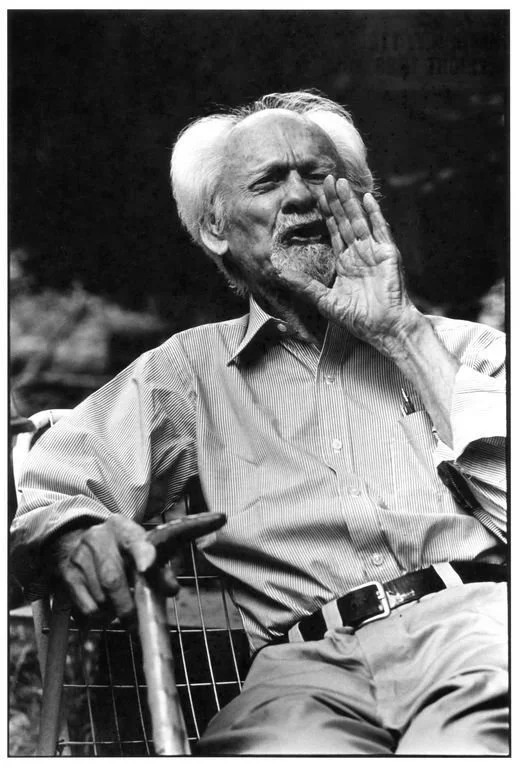
Photo by Robert Brewer, 1989
And why should we study his work?
Kenneth Burke helped reimagine rhetorical theory during the 20th century with the hopes of providing accessible rhetorical tools to public audiences that would help us avert the most devastating consequences of human action, like nuclear war.
One of his major contributions to the field is reimagining rhetoric in terms of identification. Burke’s approach to “rhetorical criticism exposes for explicit scrutiny and careful choice the usually implicit processes of identification that otherwise operate almost invisibly on those to whom an attempt to persuade is addressed” (Clark). In other words, Burke’s approach to rhetorical criticism makes visible the invitations to identification that are at the heart of persuasion and better enables us to choose how we identify with symbols, people, groups, etc. (and how we invite identifications with others). This crucial contribution helps move us away from understanding rhetoric as merely a battle of wills and instead directs our attention to the cooperative, and divisive, moments that happen in each rhetorical encounter.
By using Burke’s work to better understand how we identify with the symbols around us, we can better choose which identifications align with our values and goals and avoid being unconsciously drawn into identifications with which we would consciously disagree.
“The progress of human enlightenment can go no further than in picturing people not as vicious, but as mistaken.”